

The Quran speaks directly to the realities of human life responsibility, weakness, accountability, hope, and mercy. Among its most comprehensive and emotionally resonant supplications is the dua recited at the conclusion of Surah Al-Baqarah (2:286):
“Rabbana wala tuhammilna ma la taqata lana bihi wa‘fu ‘anna waghfir lana warhamna anta mawlana fansurna ‘alal qawmil kafireen.”
This dua is far more than a request for ease. It is a declaration of faith, humility, and complete reliance on ALLAH. It acknowledges human limitations while affirming ALLAH’s absolute mercy, justice, and guardianship. For Muslims facing modern challenges such as emotional stress, financial pressure, spiritual fatigue, and uncertainty, this supplication remains as relevant today as it was at the time of revelation.
At equranlight.com, we aim to present authentic Quranic supplications with clear explanations, scholarly context, and practical relevance for Muslims navigating modern life.
Quranic Source and Context of Rabbana WaLa Tuhammilna Dua
This powerful supplication appears in the final verse of Surah Al-Baqarah, the longest and one of the most comprehensive chapters of the Quran. Surah Al-Baqarah addresses belief, worship, law, morality, social responsibility, and accountability. After establishing these obligations, ALLAH concludes the surah by reminding believers of a fundamental principle.
“ALLAH does not burden a soul beyond its capacity.” (Quran 2:286)
Immediately following this reassurance, ALLAH teaches believers how to ask Him for help, forgiveness, and mercy. The structure of this verse itself reflects divine compassion responsibilities are paired with mercy, and accountability is balanced with hope.
Arabic Text of the Dua
رَبَّنَا وَلَا تُحَمِّلْنَا مَا لَا طَاقَةَ لَنَا بِهِ وَاعْفُ عَنَّا وَاغْفِرْ لَنَا وَارْحَمْنَا ۚ أَنتَ مَوْلَانَا فَانصُرْنَا عَلَى الْقَوْمِ الْكَافِرِينَ
Transliteration
Rabbana Wala tuhammilna ma la taqata lana bihi, wa‘fu ‘anna, waghfir lana, warhamna. Anta mawlana fansurna ‘alal qawmil kafireen.
English Meaning
“Our Lord, do not burden us with what we cannot bear. Pardon us, forgive us, and have mercy upon us. You are our Protector, so grant us victory over the disbelieving people.”
Multilingual Understanding of Rabbana WaLa Tuhammilna Dua
| Language | Text |
| Arabic | رَبَّنَا وَلَا تُحَمِّلْنَا مَا لَا طَاقَةَ لَنَا بِهِ وَاعْفُ عَنَّا وَاغْفِرْ لَنَا وَارْحَمْنَا أَنتَ مَوْلَانَا فَانصُرْنَا عَلَى الْقَوْمِ الْكَافِرِينَ |
| Transliteration | Rabbana wala tuhammilna ma la taqata lana bihi wa‘fu ‘anna waghfir lana warhamna anta mawlana fansurna ‘alal qawmil kafireen |
| English | Our Lord, do not burden us with what we cannot bear. Pardon us, forgive us, and have mercy upon us. You are our Protector, so grant us victory over those who oppose the truth. |
| Hindi | हे हमारे पालनहार! हम पर वह बोझ न डाल जो हम सहन न कर सकें। हमें क्षमा कर, हमें माफ़ कर और हम पर दया कर। तू ही हमारा संरक्षक है, अतः हमें सत्य का विरोध करने वालों पर सहायता प्रदान कर। |
| Roman Urdu | Aye hamaray Rab! hum par woh bojh na daal jo hum bardasht na kar saken. Humein maaf farma, bakhsh de aur hum par reham farma. Tu hi hamara Maula hai, pas humein haqq ke mukhalifeen par madad ata farma. |
Tafsir and Scholarly Explanation of Rabbana WaLa Tuhammilna Dua
This dua reflects a profound state of submission that comes after accepting divine guidance and responsibility. It teaches believers to approach Allah with humility, acknowledging human weakness and the constant need for divine support. Rather than promoting reliance on personal strength alone, the supplication highlights the balance between sincere effort and Allah’s mercy.
The progression of the requests moves from seeking relief from overwhelming burdens to asking for pardon, forgiveness, and mercy, and ultimately affirming Allah as the only true Protector and source of help. Through this comprehensive plea, the dua addresses accountability, emotional vulnerability, repentance, and complete trust in Allah across every aspect of life.
Phrase by Phrase Breakdown of Rabbana WaLa Tuhammilna Dua
1. Rabbana wala tuhammilna ma la taqata lana bihi
This phrase acknowledges human weakness and emotional limitation. It does not reject trials but asks ALLAH to keep them within bearable limits. It nurtures patience, emotional balance, and reliance on ALLAH during hardship.
2. Wa‘fu ‘anna (Pardon Us)
This request seeks ALLAH’s overlooking of unintentional mistakes and shortcomings that arise from human weakness.
3. Waghfir lana (Forgive Us)
Forgiveness implies the complete erasure of sins and protection from their consequences in this life and the Hereafter.
4. Warhamna (Have Mercy on Us)
Mercy encompasses divine care, guidance, emotional peace, ease in hardship, and eternal success.
5. Anta Mawlana (You Are Our Protector)
This declaration affirms that true protection and support come only from ALLAH, freeing the heart from reliance on worldly supports.
6. Fansurna ‘alal qawmil kafireen
Scholars explain that this request is not a call for aggression, but a plea for divine help against injustice, oppression, falsehood, and inner struggles including victory over one’s own ego.
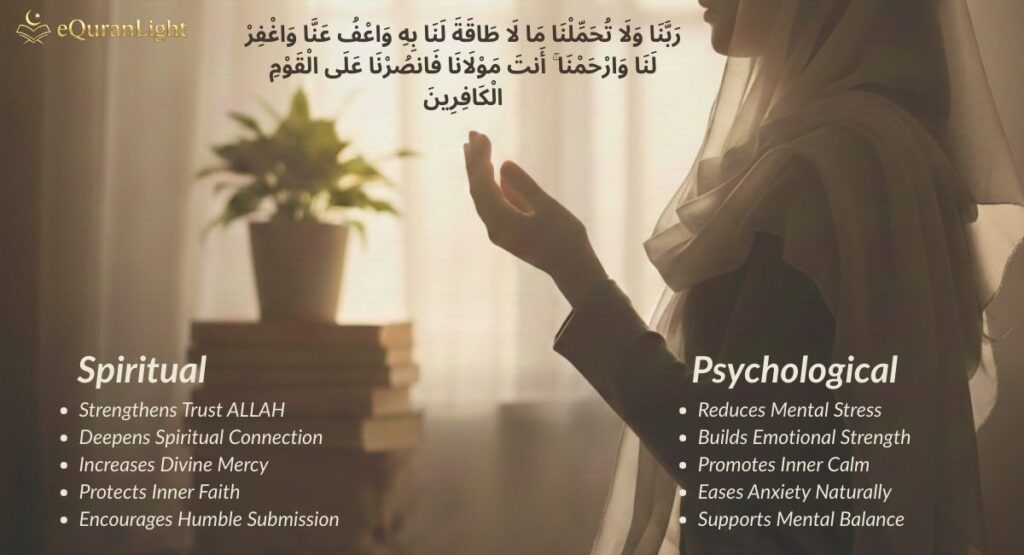
Spiritual and Psychological Benefits of This Dua
- Reduces anxiety and emotional overwhelm
- Strengthens tawakkul (trust in ALLAH)
- Encourages accountability without despair
- Builds emotional resilience and patience
- Protects the heart from hopelessness
Modern psychology recognizes the benefit of surrendering stress to a higher power. Islam provided this healing framework centuries ago through such supplications.
The Balance Between Responsibility and Mercy in Islam
The dua “Rabbana wala tuhammilna ma la taqata lana bihi” reflects Islam’s profound balance between responsibility and mercy. While the Quran emphasizes accountability, it also recognizes human weakness and emotional limits. This supplication teaches believers to strive sincerely without falling into despair or spiritual burnout. By asking ALLAH not to burden us beyond our capacity, Muslims learn that effort is required, but mercy is always accessible. This balance encourages consistency in faith, healthy repentance, and emotional resilience, reminding believers that ALLAH’s commands are always accompanied by compassion and divine understanding.
Why the Prophet ﷺ Emphasized This Dua
The Prophet Muhammad ﷺ highlighted the importance of the last two verses of Surah Al-Baqarah, stating:
“Whoever recites the last two verses of Surah Al-Baqarah at night, they will suffice him.” (Bukhari & Muslim)
Scholars explain that this dua was accepted immediately by ALLAH, making it a guaranteed source of mercy and protection for the Ummah.
When and How to Recite Rabbana WaLa Tuhammilna Dua
- After obligatory prayers
- During tahajjud and late night supplication
- In moments of anxiety, illness, exams, or financial difficulty
- Before sleeping, along with the last two verses of Surah Al-Baqarah
- As part of daily Quranic recitation
Consistency and understanding matter more than repetition alone.
Readers can explore more authentic duas, daily supplications, and Quranic guidance for personal development at equranlight.com, where faith is connected with daily practice.
Lessons for Contemporary Life

In today’s world of pressure, burnout, and uncertainty, this dua teaches timeless principles:
- Humans are not meant to carry burdens alone
- Asking ALLAH for help is strength, not weakness
- Divine mercy always precedes judgment
- True success begins with patience and faith
Final Reflection on Rabbana WaLa Tuhammilna Dua
The dua “Rabbana Wala tuhammilna ma la taqata lana bihi” is a lifelong companion for believers. It reminds us that ALLAH knows our limits, forgives our flaws, and protects those who rely on Him sincerely. When recited with understanding, this supplication nurtures inner peace, emotional strength, and unwavering faith.
At equranlight.com, our mission is to illuminate hearts with the guidance of the Quran by presenting supplications like this one with clarity, depth, and relevance for believers worldwide.
“May ALLAH accept our supplications, lighten our burdens, and grant us mercy in this world and the Hereafter”. Ameen.
(FAQs)
Q: Is this dua directly from the Quran?
Yes, it is part of Surah Al-Baqarah (2:286).
Q: Can this dua be recited for any difficulty?
Yes, it is suitable for spiritual, emotional, and worldly hardships.
Q: Is Arabic required for acceptance?
Arabic is recommended, but sincerity is essential for acceptance.
Q: Does this dua guarantee relief?
Relief comes in the form ALLAH knows best ease, patience, or reward.
Q:Is daily recitation recommended?
Yes, especially as part of the last two verses of Surah Al-Baqarah.
Q: Where can I learn more Quranic duas with explanation?
Authentic Quranic supplications with meanings, tafsir, and practical guidance are available at equranlight.com, a dedicated platform for Quran based learning.

Our Aim
At equranlight.com, our aim is to make Quran learning easy, authentic, and accessible for everyone. We teach the Quran with proper Hifz, Tajweed, Tarjama, and Tafsir helping learners understand, recite, and memorize the Quran correctly through personalized online classes. Join us and begin your journey of learning the Quran with clarity and confidence.