

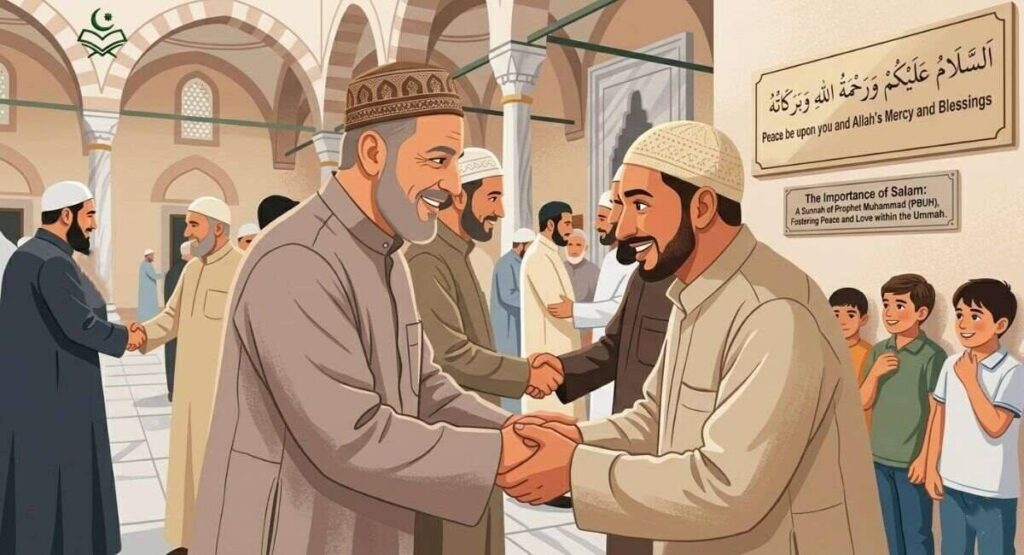
In a world filled with noise and rushed conversations, the greeting Wa Alaikum Assalam Wa Rahmatullahi Wa Barakatuh stands out as a powerful expression of peace, mercy, and blessing. Many people recognize the phrase, yet few truly understand its depth and spiritual significance. If you have ever searched for the Assalamu Alaikum meaning in English or wondered about the full Wa Alaikum Assalam meaning, you are not alone.
This beautiful greeting is more than a cultural tradition; it represents the essence of Salam in Islam and reflects the deeper Islamic greeting meaning rooted in faith and sincerity. Every time a Muslim says Assalamu Alaikum Wa Rahmatullahi Wa Barakatuh, they are offering a heartfelt prayer for peace, mercy, and divine blessings upon the other person. In return, the response carries that same prayer back, strengthening bonds of unity and goodwill. Understanding this greeting allows us to appreciate its spiritual value, social impact, and timeless role in building harmony within Muslim communities around the world.
What Does “Wa Alaikum Assalam” Mean?
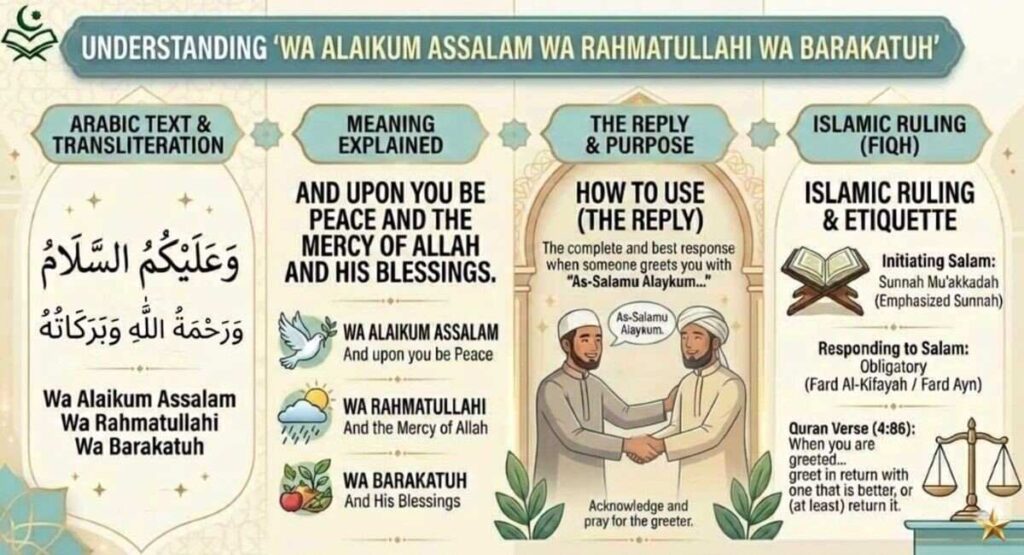
The phrase assalamu alaikum meaning in english is “Peace be upon you.” It is a dua asking ALLAH to grant safety and protection. The reply, known as the wa alaikum assalam meaning, is “And upon you be peace.” It returns the prayer with sincerity.
The complete greeting is assalamu alaikum warahmatullahi wabarakatuh, which means “Peace be upon you, and the mercy of ALLAH, and His blessings.” The full reply becomes walaikum assalam warahmatullahi wabarakatuh. This reflects the true islamic greeting meaning because Islam itself is rooted in peace. In fact, salam in islam is a symbol of security, brotherhood, and faith.
Full Arabic Text with Proper Harakat
وَعَلَيْكُمُ السَّلَامُ وَرَحْمَةُ اللَّٰهِ وَبَرَكَاتُهُ
Understanding the correct salam in arabic text helps preserve its beauty. The proper salam with harakat ensures accurate pronunciation and meaning.
Here is the greeting and reply in full:
آلسَّلَامُ عَلَيْكُم
وَعَلَيْكُمُ السَّلَامُ وَرَحْمَةُ اللَّٰهِ وَبَرَكَاتُهُ
The vowel markings guide pronunciation. Without them, non-Arabic speakers may mispronounce important sounds. Learning the correct form strengthens your connection to Quran and Sunnah.
| Type | Arabic | Meaning |
| Greeting | آلسَّلَامُ عَلَيْكُمْ | Peace be upon you |
| Full Reply | وَعَلَيْكُمُ السَّلَامُ وَرَحْمَةُ اللَّٰهِ وَبَرَكَاتُهُ | And upon you be peace, mercy, and blessings |
This greeting also connects to As-Salaam (Name of ALLAH), one of the most beautiful names of ALLAH.
Transliteration & Correct Pronunciation
Many people struggle with proper salam pronunciation. The correct salam transliteration is:
As-salamu ʿalaykum wa raḥmatullahi wa barakatuhu
Wa ʿalaykumu s-salamu wa raḥmatullahi wa barakatuhu
Pronounce it calmly. Do not rush the words. Pay attention to the sound of “ʿayn” in “ʿalaykum.” Good pronunciation reflects respect and mindful dhikr of ALLAH. Teaching children proper pronunciation ensures this Sunnah continues correctly for generations.
How to Reply to “Assalamu Alaikum” Properly?
Many Muslims ask, how to reply to assalamu alaikum correctly. The Quran clearly instructs believers in Surah An-Nisa (4:86) to return greetings with equal or better words.
The minimum response to salam alaikum is “Wa alaikum assalam.” The better reply adds “wa rahmatullah.” The best reply completes the phrase fully. Scholars classify giving salam as a Sunnah practice, while replying is generally obligatory under a wajib ruling in Islamic rulings (fiqh).
This structure creates mutual respect. One spreads peace voluntarily. The other must return it.
Importance of Salam in Islam
The importance of salam in islam is deeply emphasized in authentic hadith. Prophet Muhammad ﷺ encouraged Muslims to spread salam among themselves to increase love. This is recorded in Sahih al-Bukhari and Sahih Muslim.
In a narration reported by Anas ibn Malik in Al-Adab Al-Mufrad, the Prophet said that salam is a name placed on earth. This connects directly to As-Salaam (Name of ALLAH). When believers greet each other, they reflect divine peace. This strengthens Islamic manners and community unity.
Origin of Salam Story of Adam (AS)
The origin of salam goes back to the creation of humanity. According to a narration reported by Abu Hurairah (RA), the Prophet ﷺ said that when Allah created Adam (AS), He instructed him to greet the angels. This famous story of Adam and the angels appears in Sahih al-Bukhari (Hadith 6227) and Sahih Muslim (Hadith 2841).
Adam said, “As-Salamu Alaikum.” The angels replied, “As-Salamu Alaika Wa Rahmatullah,” adding mercy to his greeting.
This narration teaches two important lessons. First, salam is divinely taught and part of human nature from the very beginning. Second, adding good words such as “Wa Rahmatullah” increases reward and reflects greater generosity in greeting.
Etiquette (Adab) of Giving Salam “Who Greets Whom?
Islam provides clear islamic greeting etiquette about who greets first in islam. In an authentic narration in Sahih al-Bukhari, PROPHET MUHAMMAD ﷺ said:
یُسَلِّمُ الصَّغِیْرُ عَلَی الْکَبِیْرِ وَالْمَارُّ عَلَی الْقَاعِدِ وَالْقَلِیْلُ عَلَی الْکَثِیْرِ
“The young should greet the old, the one passing by should greet the one sitting, and the smaller group should greet the larger group.”
This hadith defines the proper adab of salam. It promotes humility and order. The younger honors the elder. The moving person initiates peace. The smaller group shows respect to the larger one.
These etiquettes prevent arrogance and confusion. They build discipline in families, mosques, and gatherings.
Ruling of Salam in Islam (Fard, Sunnah, or Wajib?)
Understanding the ruling on salam in islam is important. Scholars agree that initiating salam is a confirmed Sunnah practice. Replying is generally obligatory under a wajib ruling.
A narration in Sunan Ibn Majah mentions that Muslims were commanded to greet their leaders and each other. Some scholars classify repeated greetings as a mustahab action, meaning recommended but not required.
This balanced approach shows the depth of Islamic rulings (fiqh).
Can You Say Salam to Non Muslims?
The topic of greeting non muslims in islam is often discussed, especially in multicultural societies. According to narrations reported by Anas ibn Malik, when greeted by some People of the Book, Muslims were instructed to respond with “Wa alaikum.”
This people of the book greeting reply shows wisdom and balance. Scholars differ regarding initiating salam to non Muslims. Context matters. Islam encourages kindness without compromising principles.
Virtues & Rewards of Saying Salam
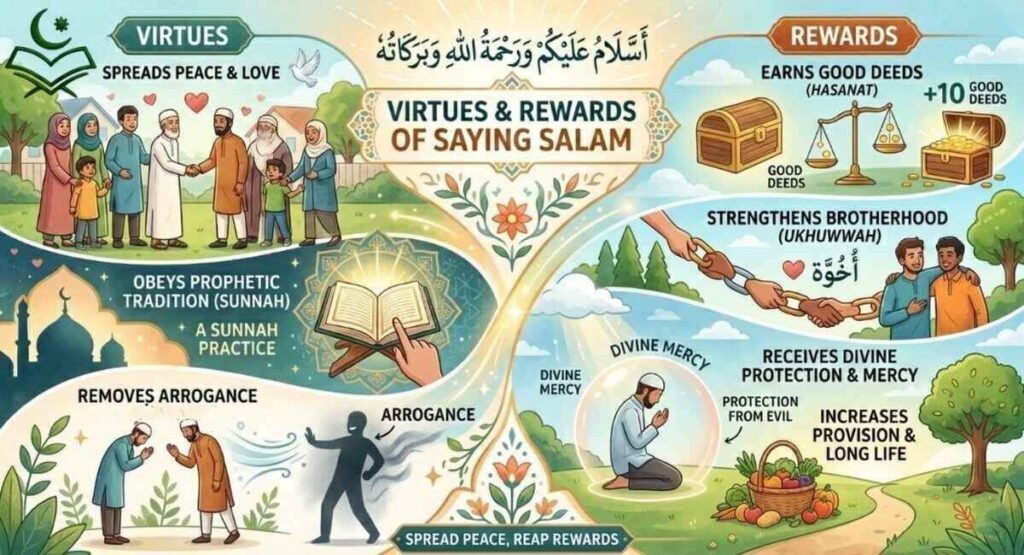
The virtue of saying salam is immense. In a famous narration reported by Imran ibn Husayn in Jami at-Tirmidhi, the Prophet ﷺ explained the increasing rewards.
| Greeting | Reward |
| As-salamu alaikum | 10 rewards |
| + wa rahmatullah | 20 rewards |
| + wa barakatuh | 30 rewards |
This well known ten twenty thirty rewards hadith clearly shows the increasing reward for salam in islam. A few extra words multiply blessings. Salam spreads barakah and strengthens faith.
Salam “A Name of ALLAH and a Daily Sunnah“
The concept of salam name of ALLAH reminds us that Allah is perfect and free from all defects. Indeed, as-salaam one of names of ALLAH reflects absolute peace and safety.
When you say Wa Alaikum Assalam Wa Rahmatullahi Wa Barakatuh, you are not just greeting someone. You are remembering ALLAH. You are practicing a Sunnah. You are spreading peace.
Final Words
The greeting Wa Alaikum Assalam Wa Rahmatullahi Wa Barakatuh carries history, faith, and reward. From the time of Adam to the teachings of Prophet Muhammad, this greeting remains unchanged.
Revive it in your home. Teach it to your children. Use it with sincerity. Through this simple Sunnah, hearts soften and communities strengthen.
May ALLAH make us among those who spread peace and receive its reward.
FAQs “Wa Alaikum Assalam“
1. What does Wa Alaikum Assalam mean?
Wa Alaikum Assalam means “And upon you be peace.” It is the reply to the Islamic greeting Assalamu Alaikum.
2. Is it obligatory to reply to Salam?
Yes. According to Quran 4:86, replying to a greeting with equal or better words is obligatory in Islam.
3. What is the complete reply to Assalamu Alaikum?
The complete reply is:
Wa Alaikum Assalam Wa Rahmatullahi Wa Barakatuh.
4. Who should say Salam first in Islam?
The Prophet ﷺ taught that the young should greet the elders, the one walking should greet the one sitting, and a small group should greet a larger group.
5. Can women and men exchange Salam?
Yes, if done respectfully and within Islamic guidelines of modesty.
6. Is it Sunnah to add “Wa Rahmatullahi Wa Barakatuh”?
Yes. Adding “Wa Rahmatullahi Wa Barakatuh” increases reward and completes the greeting.
7. Can Salam be said in messages or online?
Yes. Saying Salam in texts, emails, or social media is permissible and carries reward.
8. What are the benefits of spreading Salam?
Spreading Salam builds love, unity, humility, and strengthens brotherhood in the Muslim community.

Our Aim
At equranlight.com, our aim is to make Quran learning easy, authentic, and accessible for everyone. We teach the Quran with proper Hifz, Tajweed, Tarjama, and Tafsir helping learners understand, recite, and memorize the Quran correctly through personalized online classes. Join us and begin your journey of learning the Quran with clarity and confidence.